The Complete Guide to Apparel Production Tracking & PO Management
Production tracking and purchase order management are critical for apparel brands to maintain timelines, control costs, and ensure smooth supply chains. Let us guide you through the elaborate process and show why modern solutions like TrackIT are essential to get real-time visibility, reduce delays, and improve delivery.
Triple Tree Solutions
Published
July 29, 2026
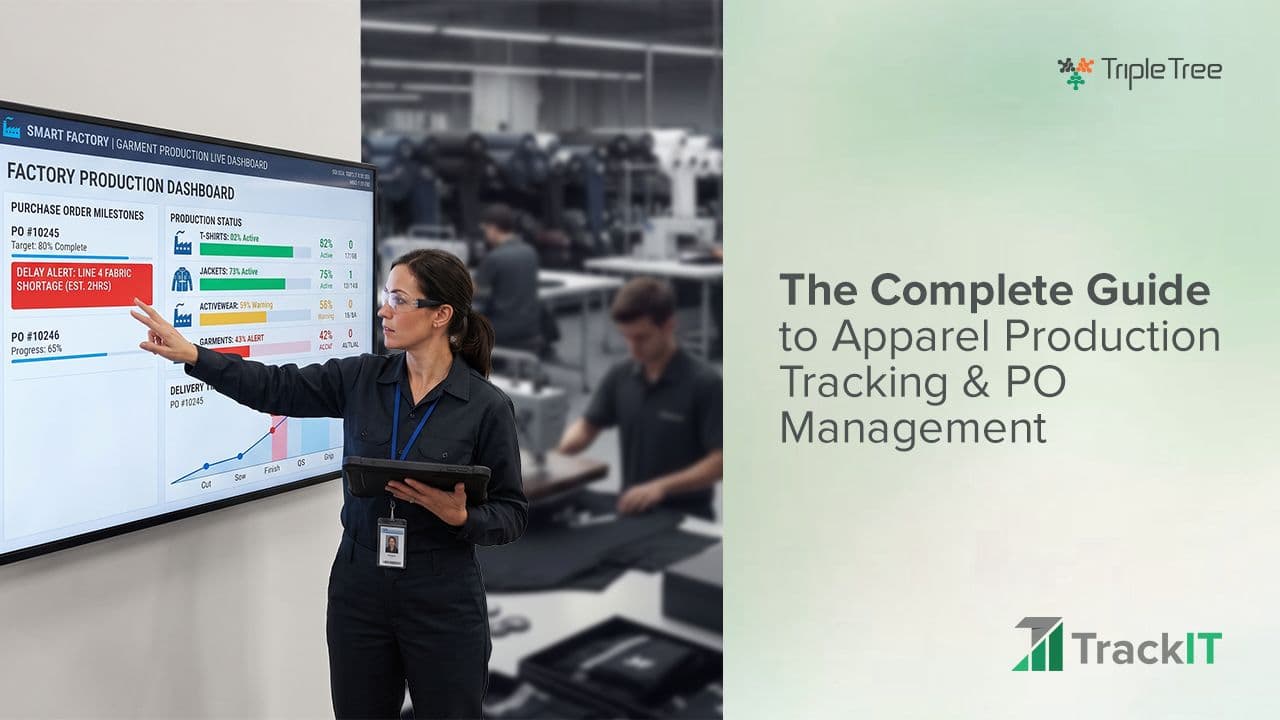
The modern apparel supply chain is more fragmented today than ever before. It spans across multiple continents, hundreds of vendors, and thousands of moving SKUs. On a micro level, each purchase order (PO) involves a series of handoffs, approvals, and dependencies.
For brands, managing timelines is becoming difficult due to rising geopolitical instability, tariff fluctuations, and supply chain disruptions. Poor production visibility is one factor that contributes to retailers losing $1.75 trillion annually to inventory distortion. The result stems from the disconnect between what's actually in production and what systems assume is on the way.
Without centralized data, managing hundreds of POs through manual spreadsheets and disconnected systems is not only inefficient but high-risk.
Even a minor delay in fabric sourcing, sampling, or production derails the entire timeline and leads to missed deliveries and rising operational costs. According to McKinsey & Company, brands need to enable efficiency and collaboration to achieve competitive advantage.
Real-time apparel production tracking is therefore critical to get better control, visibility, and reliability. This guide provides a comprehensive overview of how brands and manufacturers can improve PO management.
We explore apparel production workflows, key milestones, common challenges, supplier collaboration, and how digital solutions like TrackIT help monitor orders, reduce delays, and improve on-time delivery.
What Is Apparel Production Tracking
It is the process of monitoring, managing, and reporting garment manufacturing from purchase order confirmation to final shipment. It enables apparel brands, manufacturers, and retailers to track activity, ensure orders move according to schedule, and comply with the delivery requirements.
Unlike manufacturing sectors where tracking centers on machine schedules and fixed production lines, apparel tracking is different due to
- High SKU variation (each style, size, and color combination moves separately)
- Tight seasonal windows that leave little room for delay
- Manual, labor-intensive steps like sewing and finishing that resist full automation
- Multiple suppliers, factories, and production teams working across different locations
In a market dominated by fast-changing trends, shrinking seasons, and demanding e-commerce timelines, lead time accuracy is everything.
Here is why tracking matters in apparel production
- Financial Margin Protection
When production runs behind schedule, brands are forced to rely on expensive air freight instead of sea shipping to meet launch deadlines.
- Inventory and Retail Velocity
Modern retail relies on strict drop dates. A two-week delay at the factory level causes a brand to miss an entire seasonal shopping peak (like back-to-school or holiday launches).
- Supplier Accountability:
Without structured tracking metrics, it is nearly impossible to objectively evaluate which vendors are consistently fulfilling deadlines and which ones are delaying the operations.
Real-time production tracking helps avoid costly rush shipping, protects critical retail windows, and gives brands objective data to oversee vendor performance.
Understanding the Apparel Production Process and Workflow
Apparel production is a sequence of interdependent steps, from purchase order to shipment. Each phase depends on the one before; a delay or miscommunication at any point ripples forward.
For example,
- a fabric issue at sourcing that affects sampling
- a late approval that delays the cutting activity
- a rushed sewing stage that risks quality
Therefore, understanding the garment manufacturing is necessary to evaluate the risks and ensure effective tracking.
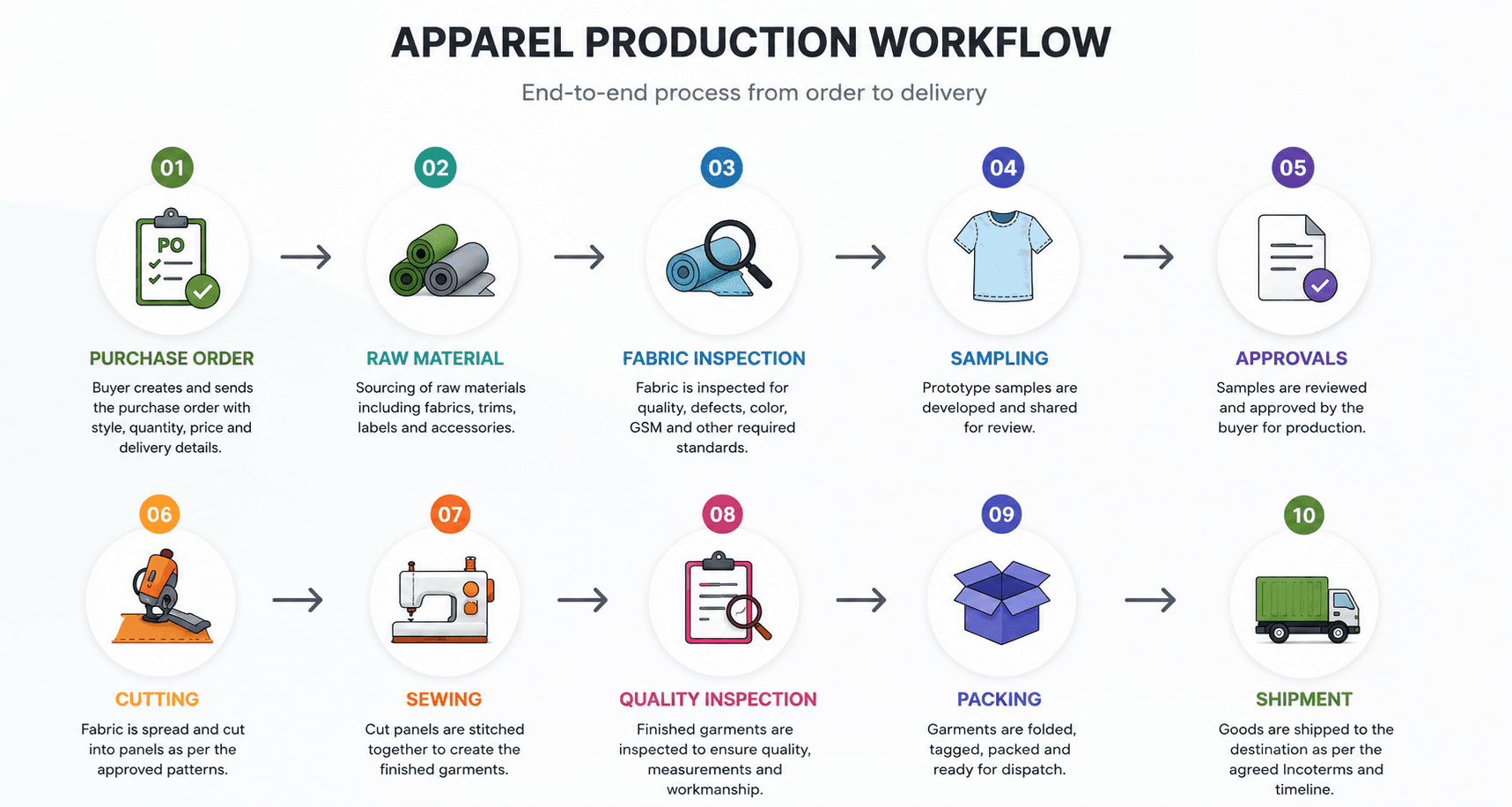
Key Production Milestones in Apparel Manufacturing
Not every step in the apparel production process carries equal weight for tracking. There are certain checkpoints where a brand needs a clear status update to catch problems before they cascade into missed deadlines. These are the milestones worth watching closely, and what should be monitored at each one.
1. Purchase Order (PO)
The production journey starts when a Purchase Order (PO) is issued from the buyer to the manufacturer or vendor. It is a document that outlines product specifications and instructions and has a specific number PO145 for tracking purposes.
What to track:
- PO approval status
- Order quantity and style details
- Delivery deadlines
- Buyer revisions
- Factory allocation
2. Raw Material Procurement
Once the PO is confirmed, manufacturers source fabrics, trims, labels, accessories, and packaging. Material availability is the most critical variable in the entire timeline as any delay postpones sampling, cutting, and sewing before production even starts.
What to track:
- Fabric booking
- Trim availability
- Supplier confirmations
- Material delivery dates
- Inventory readiness
3. Fabric Inspection
Before garment manufacturing begins, fabric is checked against required parameters to ensure suitability for production. Detecting issues before cutting helps minimize waste, reduce rework, and maintain product quality. Digital inspection helps to improve traceability and supplier accountability.
What to track:
- Fabric inspection status
- Defect rate
- Shade variation
- GSM and construction
- Inspection approval
4. Sample Development
Samples help validate the garment design, construction, measurements, and overall fit before bulk production begins. Brands review multiple sample types including fit samples, proto samples, and pre-production (PP) samples to ensure all specifications are met. Timely feedback and revisions during this stage help prevent costly production changes later.
What to track:
- Sample type
- Submission dates
- Buyer comments
- Revision status
- Final sample approval
5. Buyer Approvals
Bulk production should not start until every required approval is in like fabric, trim, lab dips, print strike-offs, PP samples and packaging. A single missing sign-off can halt manufacturing entirely, which is why approval timelines need active tracking rather than assumption.
What to track:
- Fabric approvals
- Trim approvals
- Lab dip approvals
- PP sample approval
- Packaging approval
6. Cutting
With materials and approvals finalized, fabric is spread and cut against approved markers and patterns. Precision matters here most as cutting errors are difficult to correct later. Tracking cutting ensures sufficient garment panels are available to meet sewing schedules and daily production targets.
What to track:
- Cutting start date
- Daily cutting output
- Bundle status
- Fabric utilization
- Cutting completion
7. Sewing
Sewing is the core manufacturing stage where garment components are assembled into finished products. Production managers monitor numerus factors like sewing line efficiency, operator productivity, and daily output to ensure production remains on schedule. Continuous tracking helps identify bottlenecks, balance workloads, and improve factory performance while maintaining quality standards.
What to track:
- Line loading
- Daily output
- WIP
- Line efficiency
- Production status
8. Quality Inspection
Quality inspections are performed throughout production to identify defects before garments reach the customer. Inline inspections detect issues during sewing, while final inspections verify workmanship, measurements, appearance, and packaging. Consistent quality monitoring reduces rework, improves first-pass yield, and helps maintain compliance with buyer quality standards.
What to track:
- Inline inspection
- Final inspection
- Defect rate
- Corrective actions
Learn more about apparel quality inspections and best practices work in our Complete Guide to Textile & Apparel Quality Inspection.
9. Packing
Once garments pass final quality inspection, they are folded, tagged, packed, and prepared for shipment per specifications. Accurate is crucial to avoid shipment discrepancies, incorrect labeling, or customs issues. Monitoring the packing progress ensures orders are completed and ready for dispatch as planned.
What to track:
- Packing progress
- Carton allocation
- Label verification
- Packing completion
- Shipment readiness
10. Shipment
Shipment is the final milestone in the apparel production process, where finished goods leave the factory. Production teams coordinate with freight partners, prepare shipping documentation, and ensure deliveries align with agreed timelines and Incoterms. Tracking status not only provides visibility but also lets a brand measure on-time delivery performance.
What to track:
- Shipment booking
- Container loading
- Export documentation
- Dispatch date
- Estimated delivery
Purchase Order (PO) Management in Apparel Industry
The PO is not just a starting point of production but a reference document to measure every milestone. Managing a PO well means keeping it accurate, current, and visible as production moves forward.
Core elements of a production-ready PO:
- Buyer and Manufacturer Information
It includes the basic details like names, contacts, PO number issue date, and billing information)
- Style Details
Each garment has a distinctive style name or code that also shows the product category, color, season or collection, and any SKU reference the brand uses.
- Quantity by Size and Color
A full breakdown that clearly defined the color, style, quantity, and size so the factory can plan cutting, labels, and packing accurately.
- Fabric and Trim References
It points to the approved fabric, trim, and BOM versions rather than repeating every spec. The manufacturer or supplier should know which fabric, artwork, lap dip, and packaging is approved for the order.
- Label, Artwork, and Packaging Requirements
Private label production usually includes labels (woven, printed, and care) along with particular artwork and hangtags. Each should be identified by file name and version, so a factory does not work from an outdated file from an earlier sample round. If the label or artwork is pending, mark them clearly as open.
Once issued, a PO does not remain static but remains at a focal and reference point.
For example,
- sampling gets validated against its specifications,
- cutting quantities trace back to its size/color breakdown
- shipment gets measured against its delivery date
Any revision to quantity, cost, or delivery date must be updated between the buyer, factory, and vendor.
Common PO Management Pitfalls and How to Avoid Them
A few recurring mistakes account for most PO-related delays:
- Vague Style Instructions
A name or category alone is not enough, and production workflow involves a style code, color name, and approved sample reference.
- Quantity without Clear Size/Color Details
A factory cannot plan cutting, labels, or packing off a single number. Total quantity with size and color breakdown is necessary.
- Not Updating Old Files
The presence of outdated artwork or measurement sheets is a big risk to production. Name files with clear version dates and confirm the current one before cutting starts.
- Leaving Packaging Decisions until the End
Brand should confirm packaging requirements at the same time as fabric and trim, not after and do not leave it for last.
- Underestimating MOQ Risk
A style can be dropped by a supplier entirely if the ordered quantity doesn't meet their minimum order requirement. Confirming MOQ compatibility during range planning, before the PO is finalized help avoid any gaps and discrepancies.
The Importance of Apparel Time and Action (T&A)
A Time and Action (T&A) calendar turns milestones and PO dates into a single working schedule. Rather than tracking approvals, cutting, and shipping as separate items, a T&A plan calculates backward to assign strict deadlines to every milestone.
Each milestone is marked against its target date, with a current status of on track, at risk, or delayed. Some milestones sit on the critical path, meaning any delay there pushes the final ship date directly with little time to recover. For instance, late fabric delivery cannot be recovered by working faster later.
A functional T&A calendar balances the Planned Date against the Revised Date and the Actual Date. In classic supply chains, maintaining this calendar requires hours of manual data entry every day across dozens of separate Excel files. If the vendor forgets to update a single cell, the brand remains completely blind to a missed deadline until it's already too late.
Learn more about how a Time and Action calendar works in textile production and how to optimize it
The Common Challenges in Apparel Production Tracking
Garment production rarely follows a linear path. Buyer requirements can shift, timelines can tighten, and unexpected issues can surface at every stage. As multiple processes run simultaneously across different vendors and locations, small issues can compound quickly into larger delays.
Understanding the common production tracking challenges is the first step toward improving visibility, reducing delays, and delivering orders on time.
- Global Supply Chain Complexity
Sourcing spans multiple countries and processes from fabric inspection and cut-and-sew, to finishing. Brands often use advanced ERP systems, but their offshore vendors use paper logs or basic spreadsheets. The data gap between brands and factories creates blind spots.
- Data Silos and Manual Reporting
Production status often lives in disconnected spreadsheets, email threads, and text messages. Subsequently, it takes time for the sourcing teams to know if the sample was approved or shipped.
- Capacity constraints and Factory Overbooking
Factories sometimes commit to more orders than they can realistically deliver on schedule. However, without visibility into actual factory load, brands find out late when a deadline is already at risk.
- Tariff and Trade Policy Volatility
The unpredictable tariffs shift will continue to impact textile sourcing and production in 2026. Furthermore, the ongoing Middle east crisis is further adding complexity to an already disrupted supply chain.
- Frequent Purchase Order and Design Changes
Late changes to quantity, color, or design ripple backward through sampling, cutting, and sewing impact the final delivery date.
- Quality Issues and Rework
Defects identified late in production trigger rework and consume time already allocated for later stages which pushes back the whole schedule.
The Role of Suppliers and Vendor Coordination
Every apparel order runs through more than one stakeholder as brand rarely deals directly with a single factory. Mills, trim suppliers, cut-and-sew vendors, and finishing houses each contribute to a piece. However, each one operates on its own systems, timelines, and communication habits.
Coordination between the stakeholders is difference for an order that stays on track and one that quietly drifts. The factors that affect
- Inconsistent Reporting Formats
One vendor may send updates via email, while another via WhatsApp. Without a shared format, comparing status across vendors becomes manual and time-consuming work.
- Time zone and Communication Lag
A status question sent at the end of a brand's workday might not get answered until the vendor's next business day, quietly adding a full day to every back-and-forth.
- No Single Source for Updates
When a PO revision or approval isn't communicated to every vendor at the same time, one vendor ends up working from outdated information.
The Apparel Production Tracking Methods and How They Work
Coordination is good, but it alone does not solve the underlying problem. Someone still has to capture, update, and share production status across every vendor and milestone.
'How' that happens varies from one brand to the other.
Traditional Tracking Methods
Most brands still track production the way they always have:
- Spreadsheets updated manually after status calls or emails
- Wall charts or printed T&A calendars marked up by hand; and
- Reports compiled at the end of each week rather than as things happen.
These methods do work, but every update depends on someone remembering to enter it. By the time a report is compiled, the information it contains is already a few days out of date. A delay that happened on Monday might not surface in a status report until Friday. As a result, the time for adjustments without added cost has often already closed.
How Digital Production Tracking Systems Work
Digital systems replace the old method with continuous and real-time status updates. Rather than manual entry into a spreadsheet, vendors and factories log status directly against each milestone as it happens. Whether it is a completed cutting stage, a sample submitted for approval, a shipment booked. The status detail is visible to everyone with access immediately, and not at the next scheduled check-in.
Digital platforms like TrackIT follow the same mechanism where purchase orders, milestones, and vendor updates all live in one connected system. A brand can see exactly where every order stands without chasing a status update by email. Delays get flagged automatically against the T&A calendar the moment a milestone slips. Corrective actions can be performed quickly to avoid late deliveries.
Traditional vs. Digital Production Tracking
| Aspect | Traditional Tracking | Digital Tracking |
|---|---|---|
| Data Capture | Manual entry, updated periodically | Real-time updates as milestones happen |
| Visibility | Fragmented across spreadsheets, emails, and calls | Centralized, single source of every update and detail |
| Delay Detection | Identified during scheduled check-ins, and often after the fact | Flagged automatically against the T&A calendar |
| Vendor Coordination | Inconsistent formats, and manual follow-up | Standardized reporting and timely communication across all vendors |
| Scalability | Difficult to manage as PO volume increases | Expandable and flexible to handle hundreds of orders without added manual effort |
From Manual to Digital: How TrackIT Closes the Visibility Gap
TrackIT is a SaaS-based tracking software that consolidates all pre-production and active production milestones. It gives you the visibility essential to manage PO and keep deliveries on schedule.
Built by Triple Tree Solutions, it replaces manual spreadsheets and scattered vendor updates with a single, real-time view of every order. Rather than trying to bend a generic manufacturing ERP to fit fashion workflows, TrackIT digitizes the exact journey a garment takes from raw yarn to final container shipment.
Key Features of Apparel Production Tracking Software
TrackIT transforms intricate and disorganized data into structured, actionable workflow through an array of advanced features:
Placement Summary
Instantly benchmark current production placement against previous years that helps teams spot output trends. The seasonal planning is based on historical performance data rather than guesswork. For each new season, TrackIT enables teams to analyze current volumes and timelines against past cycles and avoid recurring issues.
Delivery Performance
Gives clear visibility into every order's status from production through shipping. TrackIT provides objective, comparable data that makes real vendor accountability possible, rather than relying on past performance. The data is useful both for day-to-day decisions and renegotiating terms when a pattern becomes clear.
Production Reports
TrackIT delivers actionable insight into vendor efficiency, quality control, and team performance. It prevents the effort and time required to compile separate spreadsheets for internal reviews and external buyer updates.
Production Progress Tracker
Shows every order and every milestone in one place, in real time. Whether it's a single high-priority order or hundreds running in parallel across multiple factories, this is the view a production manager returns to first each day to see what needs attention.
Predictive Algorithms
Analyzes delivery patterns to flag orders at risk of running late before they actually do. This shifts a team's role from reacting to delays to catching them while there's still time to act. Instead of discovering a problem only once a shipment date is already at risk, teams get an earlier signal. They can adjust a schedule or have a proactive conversation with a vendor.
Dashboard and Analytics
Consolidates data from every vendor and factory into one visual, drillable view the "bird's-eye". Teams can move from a company-wide view down to a single order without switching tools. TrackIT provides data that can help whether it's an executive scanning overall on-time performance and a production manager troubleshooting one delayed style.
Chat and Supporting Docs
Centralizes communication and file-sharing across factories, vendors, and brand teams, so approvals and updates are available to all stakeholders. TrackIT can help locate information about a specific PO months later. The full details and file history are attached to that order and not buried in a mail among dozens of unrelated threads.
Real Results: How TrackIT Cuts Production Delays
An apparel manufacturer worth $250 million operating across multiple continents, with a global vendor network and multiple production sites. However, even with a strong supply chain, one problem kept undermining it: 'inefficiencies in production tracking'. With vendors spread across regions, the team struggled to monitor production progress, predict delays, and maintain on-time delivery. What they needed was a centralized, digital production management solution capable of giving them complete visibility over their supply chain system.
Triple Tree Solutions implemented TrackIT to digitize their workflows and standardize production data across every vendor. It replaced scattered spreadsheets and email threads with real-time order tracking and provided an advanced dashboard instead of siloed updates.
The result: a 40% reduction in production delays. As the manufacturer put it, TrackIT helped them "spot delivery issues well in advance," turning what used to be reactive in firefighting into planning with real lead time.
The Future of Apparel Production Management
The apparel supply chains will become more distributed, and consumer expectations for speed will keep increasing. Let us view the factors that will shape the future of apparel production tracking.
Predictive Visibility and not Just Reactive
Instead of reporting where an order stands today, tracking systems are increasingly built to flag risk before it materializes. It helps to identify risk orders early for teams to intervene and perform corrective actions.
Detailed ERP and PLM Integration
With fast fashion becoming the new normal, brands will have to manage more SKUs across multiple vendors. It means tracking data will move away from standalone tools and toward digital solutions that support ERP/PLM integration. The purpose is to reduce duplicate data entry and keep specs, POs, and production status connected to one platform.
Greater Supply Chain Transparency
Regulations such as DPP and buyer pressure for traceability is increasing across the industry. The need for digital tracking with a timestamped record of every milestone is becoming benchmark proof instead of mere transparency claims.
Resilience Against Trade and Tariff Volatility
The sourcing costs and routes shifting is now becoming common with changing dynamics in global politics. Real-time visibility into every order shows the brand’s efficiency alone to deal with supply chain disruptions.
IoT and Real-Time Data Capture
Tools like connected measuring devices and location tracking are starting to reduce reliance on manual status updates. Capturing data directly from the production floor saves considerable time and ensures accurate information.
Conclusion
Apparel manufacturing covers numerous minor and major tasks that are difficult to track with just emails and spreadsheet. Every stage from a confirmed PO to the final shipment can be streamlined with accurate data and real-time visibility.
Relying on traditional methods leaves brand and manufacturers vulnerable to costly delays, air-freight expenses, and strained vendor relationships. Transitioning to a digital platform like TrackIT gives you the real-time visibility and actionable insights to quality control and vendor efficiency to ensure timely delivery.
See what Real-time Production Visibility could mean for your Supply Chain.
The Apparel Production Tracking Checklist
The following checklist will allow you to evaluate your current production tracking process and ensure it aligns with industry’s best practices.
☐ PO Accuracy: Does every PO include a full size/color breakdown, referenced sample version, and confirmed file versions for labels and artwork?
☐ Milestone Visibility: Can your team see the status of every key milestone from PO confirmation to shipment without requesting a manual update?
☐ T&A Discipline: Is there a working Time and Action calendar in place, with critical-path milestones clearly identified?
☐ Vendor Reporting Consistency: Do all vendors report status in a standardized format, rather than a mix of emails, calls, and spreadsheets?
☐ Real-Time Delay Detection: Are delays flagged automatically as they happen, or only identified during scheduled check-ins?
☐ Vendor Performance Data: Can you objectively compare on-time delivery performance across vendors, backed by data rather than impression?
☐ Digital Integration: Is production and PO data centralized on a shared platform like TrackIT, or still fragmented across spreadsheets and inboxes?
TRENDING NOW
Community Favorites

Industry Events
What to Expect at PI Apparel’s Fashion Technology Show NYC 2026

Triple Tree Solutions
Jul 15, 2026

QUALITY
The Complete Guide to Textile & Apparel Quality Inspection
Triple Tree Solutions
Jul 2, 2026
QUALITY
The Complete Guide to Textile & Apparel Quality Inspection
Triple Tree Solutions
Jul 2, 2026
PRODUCTION
From Yarn to Shipment: How TrackIT Optimizes Textile Workflow
Triple Tree Solutions
Jun 16, 2026